
Searching the Fayette County Court Docket
Start with Indiana MyCase. It is the free public window into Fayette Circuit Court and Fayette Superior Court dockets, and it searches cases held in Odyssey. You can pull up a Fayette County case by number, citation, or cross-reference number. Searching by name works too. It covers a person or a business, and lawyers can be found by name or bar number. Pick Fayette County first, then trim the results by court, category, status, or file-date range. A case number is usually the cleanest route.
Check the result row before you open anything. The cause number, court, file date, case type, status, and caption all need to match. Similar names are not enough. Inside the case summary you get the header and party roles. Chronological Case Summary events, hearing blocks, document links, and limited financial data appear there too. Treat MyCase as a convenience. It may show errors or omissions, and it is not the official court record.
- Choose Case, Name, or Attorney search.
- Select Fayette County and the correct category.
- Narrow status or dates when results are broad.
- Open the matching court and cause number.
- Verify the newest event and hearing block.
- Ask the clerk for an official or certified record when required.
Fayette MyCase Before Travel
A few minutes in MyCase can spare you a wasted drive. The courthouse trip matters less when the docket answers your question first. The search screen offers Case, Name, and Attorney tabs. You also get status and date filters, a sounds-like option for names, and a Fayette County court filter. Want wider name matches? The state's tips allow a trailing asterisk as a starts-with wildcard. In case numbers, hyphens and leading zeroes are usually optional. Two limits to know: broad searches cut off at 1,000 results. Quick repeat searches may trigger a CAPTCHA check. The official MyCase interface is where every Fayette County court docket query begins.
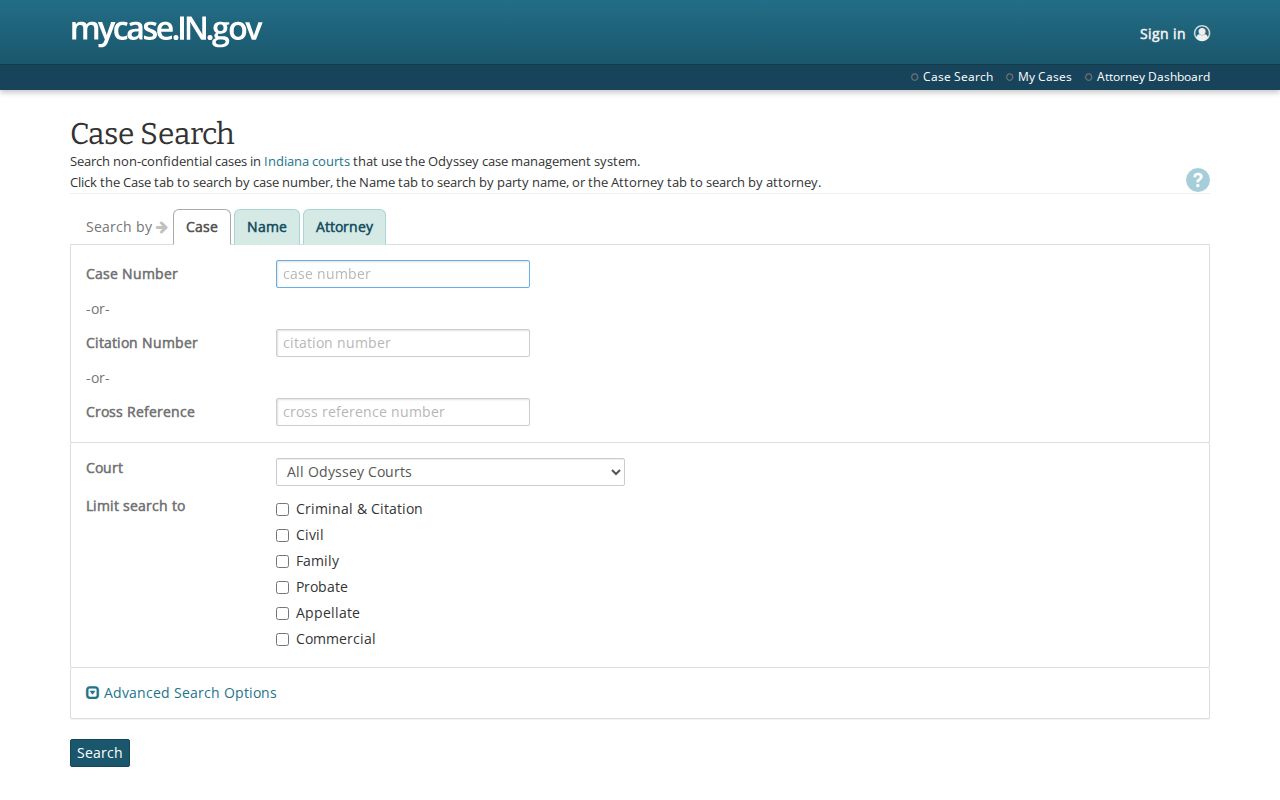
This search layer covers both Fayette trial courts, so one docket lookup can reach either bench. It is not the official record. The Fayette County clerk holds that, and the clerk's copy controls if anything ever conflicts.
Inside a Fayette County Court Docket
Indiana names its running court history a Chronological Case Summary, or CCS. Think of it as the case's diary. Every event appears in date order. A Fayette County CCS might include a new-case entry, an appearance, a charging document or complaint, a summons, motions, orders, clerk activity, scheduled hearings, a judgment, disposition, and later review. Each line can carry an event date, a description, a comment, the judge, page data, and a linked document where public access allows one.
| Header | Cause number, Fayette court, file date, type, status, and access flags. |
|---|---|
| Parties | Names, roles or connections, attorneys, and public-view limits. |
| Events | Dated filings, motions, orders, hearings, and clerk activity. |
| Settings | Court, date, time, setting text, officer, result, and cancellation status. |
| Documents | Public links where the case type and audience rules allow them. |
| Financials | Limited charges, credits, payments, balance, and as-of date when supplied. |
A short code on the CCS is never a result by itself, so read the full event description plus any signed order. Keep this in mind too: a public filing event can exist even when no PDF is posted online.
Fayette Court Codes 21C01 and 21D01
Every Fayette County case number opens with the county code 21. After that comes the court code. Fayette Circuit Court uses C01, and Fayette Superior Court uses D01. A masked felony example looks like 21C01-YYMM-F5-######, while a civil collection follows the pattern 21D01-YYMM-CC-######. The masked sequence keeps a real party's file out of view.
Treat the court code as a routing tool. It tells a caller which of the two Fayette County courts owns a docket setting. The remaining characters cover filing period, case type, and sequence. One caution belongs here. A transfer can change a cause number. The current court header and any transfer event on the docket control over the digits alone. Converted entries may also show older data moved into Odyssey rather than fresh court action. Keep that in mind when you trace a Fayette County criminal docket back through time.
Courts That Keep Dockets in Fayette County
Indiana gives every county a Circuit Court. Superior Courts exist where the state has set them up. In Fayette County that means two local trial courts and one unified clerk. Nothing separate shows up in the official Odyssey list. There is no Fayette municipal, city, town, justice, or district court. So a Connersville address does not create its own city docket.
| Court | Docket covers | Where to search |
|---|---|---|
| Fayette Circuit Court, 21C01 | General civil, juvenile, felony, and probate-related matters | MyCase, then Circuit office or clerk |
| Fayette Superior Court, 21D01 | General civil, misdemeanor, traffic-related felony, traffic, ordinance, small claims, and eviction | MyCase, then Superior office or clerk |
The Indiana Judicial Branch Fayette County page collects the state docket search, e-filing, local rules, district, and statistics links in one spot.
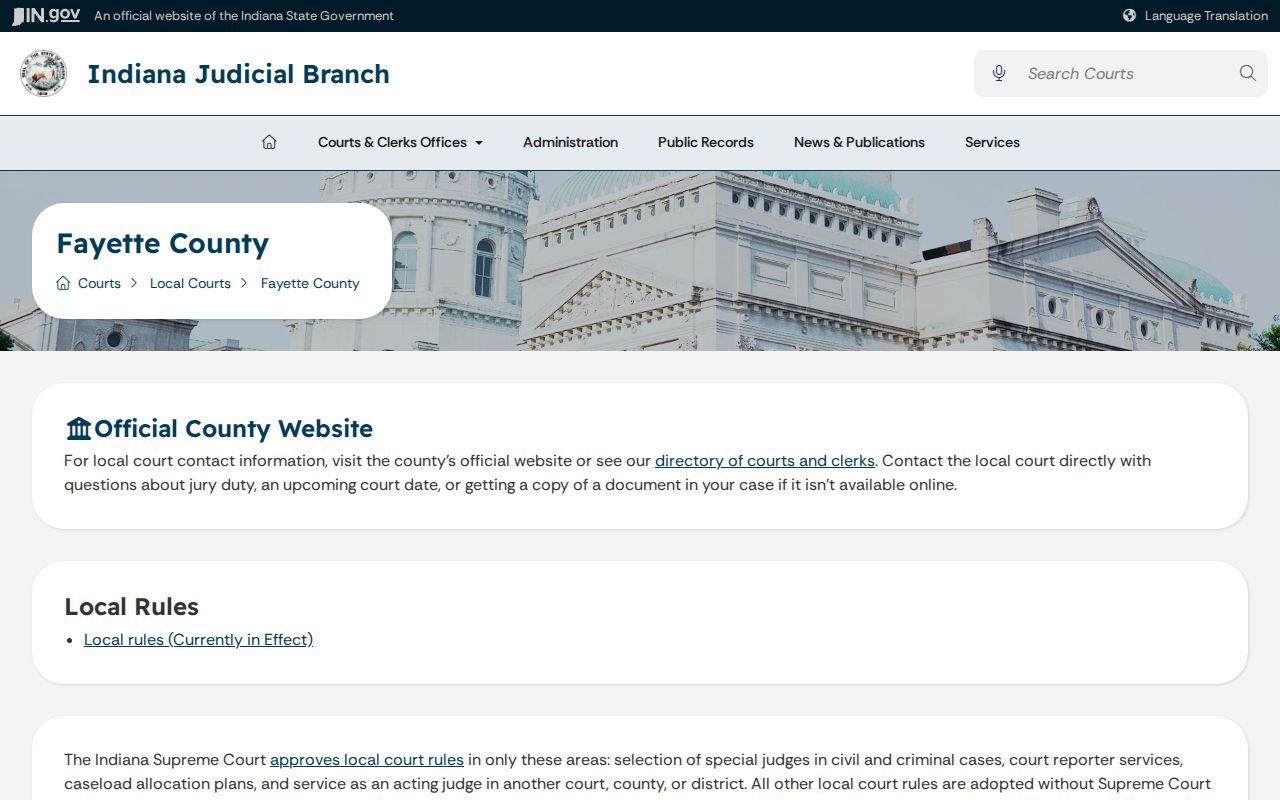
That official page works well as a bridge from the statewide tools to Fayette County trial-court details.
One Courthouse, Two Fayette Courts
Everything sits under one roof. The Fayette County Courthouse, 401 N Central Ave, Connersville, Indiana 47331, houses both Fayette court offices. It also holds the Fayette County Clerk. Head to the second floor. The clerk works from the north end. Fayette Circuit Court and Fayette Superior Court occupy the same level. Sharing a building makes the clerk the practical hub for court records. Even so, each court still runs its own docket and judicial work.
For courthouse and county-seat background, the official Fayette County homepage is the place to look. It lays out the county's own overview of the seat of government and its offices.
That courthouse holds the official Fayette County case file, and the online docket search is simply the window onto it. A separate county government directory maps every county office, which helps with justice-system questions.
Check the directory first to tell the Fayette County clerk apart from the trial courts and unrelated county offices.
How to Find Court Dates and Settings
Fayette County posts no standalone daily or weekly court calendar online. The dependable route is the hearing block inside a MyCase case summary. Pull up the cause number and open the right case. Note the court, session date, time, hearing text, judicial officer, result, and any cancellation. Then check later events for a reset or an order.
Summaries show entries such as Initial Hearing, Pretrial Conference, and Jury Trial. Treat a date-to-be-determined notice, a canceled hearing, or an assigned-in-error entry as history. It is not a live court date. Fayette local rules expect a case to stay set for its next step. Alternatively it can be reset for the same step. Jury trials generally land on Mondays, and motions needing court action should be set within sixty days where practical.
For a date that matters, call the court office directly. Fayette Circuit Court settings: 765-825-1331. Fayette Superior Court settings: 765-825-1775. A live voice at the court, not an old search result, is what confirms when you must appear.
A Fayette Reset Is Not Current
A hearing date on the Fayette County docket can sit there after the court has already changed it. Look past the first entry you see. The newest hearing block that has not been canceled, plus the CCS entries around it, tells you what actually controls, and a motion to continue, a scheduling entry, an order, a cancellation reason, or a later session can all explain the shift. When later events exist, the first date found never governs.
Quick check: If the Fayette County docket shows a canceled session or no firm date, call the owning court and ask for the newest setting.
The clerk can name the file. The judge's office controls the live setting. Fayette posts no official Zoom calendar, remote-hearing feed, weather closure feed, or daily docket PDF, so a same-day change can slip through unnoticed. Call before you travel.
Public Access to Court Dockets
Indiana Rule 4 starts from a simple premise. General public access is the default unless another rule or law excludes the record. Rule 5 lists the excluded records and the protected information inside them. Rule 6 lets a judge pull another record from public view in extraordinary circumstances. This happens through a written process. Rule 9 covers requests to inspect an excluded record. The Indiana Access to Public Records Act offers a broader request framework, though court-specific access rules govern judicial files.
Access Rule 4 states the general rule.
Access Rule 5 lists excluded records.
Access Rule 6 covers court-ordered exclusion.
Indiana Code 5-14-3 addresses public-record requests.
Juvenile, adoption, paternity, mental-health, protection-order, confidential family, expunged, sealed, and identifier-protected material may be missing or limited in a docket search. "Not online" is not the same as "sealed." A document can sit outside the public matrix while its filing event stays visible on the docket.
Why Fayette PDFs Go Missing
MyCase splits the public case summary from the underlying court file. You may see the header and CCS. Meanwhile a complaint, affidavit, order, or judgment has no public download. Availability turns on case type, document category, and audience. Older conversions can leave a thinner online history. The official MyCase coverage guidance walks through converted records, documents, privacy, payments, and data limits.
That does not erase the filing event. It just changes your next step. Write down the Fayette County court, cause number, event date, and document description. Then ask the clerk whether that exact item is public and whether it can be inspected, copied, or certified. Requesting a CCS is not the same as requesting the document behind one entry.
The MyCase terms describe the free public search and its nonofficial-record status. Portal data helps you locate and follow a case. Official proof must come from the court record itself. That distinction matters most when a result will be filed, appealed, or used to pin down the precise wording of an order.
Docket Records at the Clerk's Office
Fayette County names Dawn Hughes as its current County Clerk. Her unified office receives and maintains filings for both trial courts. That means civil and small-claims filings, protective orders, payment receipts, and the rest of the statutory clerk work in one place. There is no separate criminal, civil, probate, or district clerk.
Fayette County Clerk
Fayette County Courthouse, 2nd Floor North End
401 N Central Ave
Connersville, IN 47331
765-825-1813
Fax: 765-827-4902
Email: clerk@co.fayette.in.us
The published clerk hours run weekdays from 8:00 a.m. to 4:00 p.m., Wednesdays to 5:00 p.m., and Thursdays to 12:30 p.m. The office closes daily from noon to 1:00 p.m. for lunch. Call ahead about a terminal, a paper file, copies, certification, the accepted request channel, and the fee. The official clerk page posts the current details.
Its address, contacts, hours, filings, and payments make the clerk the trusted fallback for Fayette County court records.
What Fayette Certification Adds
A MyCase summary covers many tasks. Finding a cause number, following public events, or checking which court owns a case all fit. It is not a clerk-authenticated copy. Certification adds the clerk's formal attestation to the requested docket, judgment, or filed document. So ask for the exact product. A CCS, an individual order, a judgment transcript, and a hearing transcript are different records.
Fayette publishes no certified-copy price or general copy-request form. Give the clerk the court, cause number, document or event, and date range, then ask whether a plain or certified copy fits, what fee applies, how payment is accepted, and when it can be ready. A court reporter, not the clerk, handles a hearing or trial transcript under Indiana Trial Rule 74.
Fayette Court Access Channels
Start online with MyCase. If the case or document is missing, call the owning court. Then contact the clerk. In person, ask for the official file, plain copy, or certified product by exact cause number. The clerk also publishes an email and fax number. Its page does not promise either is an accepted copy-request route. Confirm the format before sending private information or payment.
| Channel | Best use | Limit |
|---|---|---|
| MyCase | Free summary, events, settings, selected PDFs | Not official; older or protected items may be absent |
| Court phone | Current setting and court-owned scheduling | Not a certified-copy channel |
| Clerk counter | Official file, inspection, copies, certification | Call for hours, availability, and fee |
| Email or fax | Ask about a specific request | Acceptance and turnaround are not published |
| Particularized request | Identify an existing public record | Access rules and reasonable production time apply |
Fayette publishes no mail form, drop-box method, terminal inventory, paid local subscription, or fixed copy turnaround. Indiana's general clerk guide cites a baseline. It lists $1 per legal or letter-size page, $1 for a certificate under seal, and $3 for a transcript of judgment. Fayette County may apply the governing statutory rules. Confirm the product and the total before paying. A hearing transcript is a separate product ordered from the court reporter under Trial Rule 74.
Fayette Circuit and Superior Offices
Fayette Circuit Court handles general civil matters, juvenile cases, criminal felonies, and probate-related work. Its office publishes 765-825-1331 and ciradmin@co.fayette.in.us. Fayette Superior Court takes general civil matters, misdemeanors, traffic-related felonies, traffic, ordinance cases, small claims, and eviction. Its office publishes 765-825-1775 and superiorsec@co.fayette.in.us. The Circuit Court source posts the office details.
It lists the Fayette County Circuit office's contacts, hours, jurisdiction, rules, and forms; the Superior Court page comes next.
It confirms Superior's distinct docket subjects and its Thursday public-access limitation.
Fayette County Court Dockets by City
Connersville is the only incorporated city in Fayette County. The 2020 Census counted 13,324 residents. The 2024 estimate puts the population at 13,282. Glenwood holds the status of a civil town rather than a second city. It does not add a separate city docket to this set.
The city runs no municipal court of its own. A Connersville address on a ticket does not mean a separate city docket exists. Traffic and ordinance cases tied to the city route into Fayette Superior Court. The unified clerk maintains the official case file there.
Connersville Docket Search
Search statewide first, verify Fayette Superior Court or Circuit Court, then use the clerk or court office for the official record.
City ordinance enforcement can start before anything reaches a court docket. Ask the clerk whether a cause number exists before you search for a Fayette County case.
Map and Directions to the Fayette County Courthouse
Circuit Court and Superior Court files, and the unified Clerk's records, are all kept at the Fayette County Courthouse in downtown Connersville. The Clerk's counter is on the second floor, north end; Circuit Court and Superior Court offices are also on the second floor. There is no separate criminal, civil, or family building in Fayette County — one courthouse holds every trial-court office.
Fayette County Courthouse
2nd Floor North End
401 N Central Ave
Connersville, IN 47331
765-825-1813
Weekdays 8:00 a.m. to 4:00 p.m., Wednesday to 5:00 p.m., Thursday to 12:30 p.m.; closed daily noon to 1:00 p.m.
Circuit Court keeps slightly different hours (closed Thursday afternoons) and Superior Court's Thursday office hours are not open to the public, so call the specific court before a same-day trip. Parking, security-screening, and public-terminal details are not published by the county, so confirming by phone before traveling is the safer plan.